


Blogs
How to Make IT Cost Optimization Decisions
November 13, 2025
November 26, 2025
Read time: 2.5 min
In today's rapidly evolving business landscape, IT managers are often tasked with the challenging responsibility of reducing costs without compromising the quality and efficiency of their operations. With budget pressures mounting and the need to optimize resources more critical than ever, making the right cost-optimization decisions can be daunting.
At its core, cost optimization is about balancing impact, effort, and risk. This framework outlines six key areas to consider, accompanied by a qualitative and quantitative rating system for each.
Step 1, begin by brainstorming potential cost reduction options. For each option, assess it against the questions in each of the six key areas, and assign a rating in one of the three columns provided.
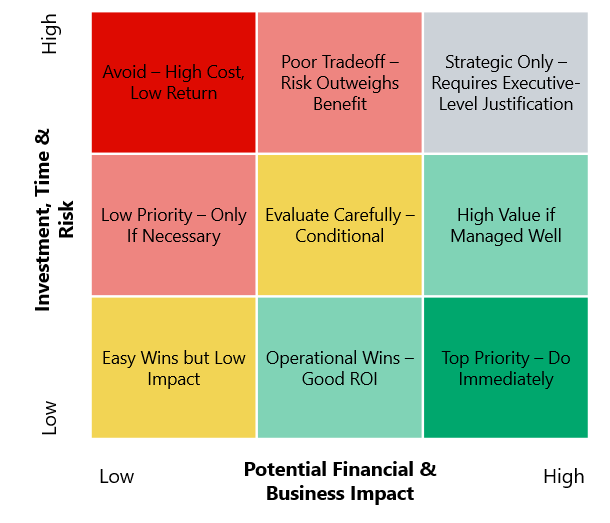
Step 2, use the evaluation table to score each initiative across the two dimensions:
1. Investment, Time & Risk
2. Potential Financial Benefits & Business Impact
Plot each initiative on the chart according to your scores. Once placed, the framework reveals the next step. This helps IT leaders quickly see where to focus resources and which initiatives are unlikely to deliver sufficient value for the effort required.
In an era where technology underpins every facet of business, cost optimization is no longer just about cutting expenses—it’s about making strategic decisions that safeguard performance while unlocking long-term value. By leveraging a structured framework, IT leaders can move beyond reactive cost-cutting and embrace a proactive approach that aligns financial discipline with innovation.
At Quadbridge, we believe that true optimization happens when organizations balance financial impact, operational resilience, and technical risk. This means evaluating initiatives not only for immediate savings but for their ability to strengthen your enterprise for the future. The most successful IT leaders are those who view cost optimization as a continuous, data-driven process—one that empowers smarter investments and sustainable growth.
Client profile
Industry: Environmental
Employees: 25-50
✓ Managed IT
✓ Managed M365
✓ Managed Backup
✓ Professional Service
✓ Managed Endpoint
After supporting Waterloo Biofilter with an office move, they quickly switched fromtheir current Managed Services Provider to Quadbridge. We now manage their entireIT environment and support their end-to-end IT needs.
• Quadbridge worked with the client to implement our Elite IT service thatprovides ongoing IT monitoring and management, responsive help desk,proactive service, and vCIO consulting
• We’ve become a fully trusted partner and have proactively led a number ofinitiatives to improve performance and advance their IT, including thefollowing services:
• Managed Cloud Backup: we optimized their backup strategy with anaccessible, cost-efficient cloud-based backup solution that our teamcontinuously monitors and assists with restore requests.
• Infrastructure Architecture: we upgraded their server infrastructure toimprove redundancy and performance – especially for employees workingremotely.
• Ad Hoc Requests: as the clients’ IT support, our team uses our range ofexpertise and onsite support capabilities to deliver on a range of simple andcomplex IT projects. These have included upgrading their conference roomsystems and completing a functional and aesthetic clean up of their cabling
Not sure where to start? Contact us for your next IT decision.
BOOK NOW1 800-501-61721 800-655-3282info@quadbridge.cominfo@dtm.ca


.png)
